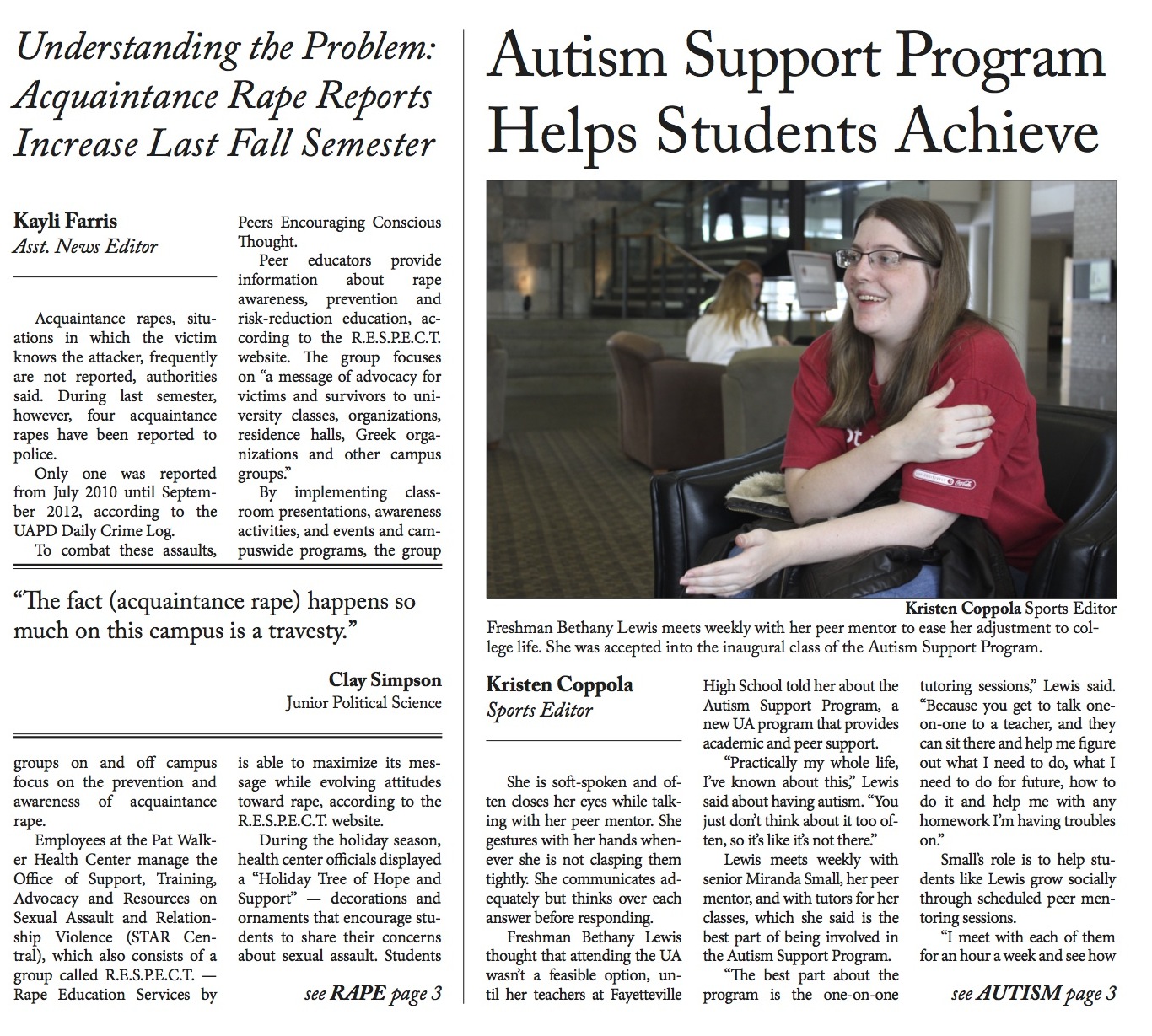
She is soft-spoken and often closes her eyes while talking with her peer mentor. She gestures with her hands whenever she is not clasping them tightly. She communicates adequately but thinks over each answer before responding.
Freshman Bethany Lewis thought that attending the UofA wasn’t a feasible option, until her teachers at Fayetteville High School told her about the Autism Support Program, a new UA program that provides academic and peer support.
“Practically my whole life, I’ve known about this,” Lewis said about having autism. “You just don’t think about it too often, so it’s like it’s not there.”
Lewis meets weekly with senior Miranda Small, her peer mentor, and with tutors for her classes, which she said is the best part of being involved in the Autism Support Program.
“The best part about the program is the one-on-one tutoring sessions,” Lewis said. “Because you get to talk one-on-one to a teacher, and they can sit there and help me figure out what I need to do, what I need to do for future, how to do it and help me with any homework I’m having troubles on.”
Small’s role is to help students like Lewis grow socially through scheduled peer mentoring sessions.
“I meet with each of them for an hour a week and see how their day’s going,” Small said. “Mostly we just talk about what they did this weekend or what are they going to do for break.”
Though social growth is not instantaneous, Small said she’s seen the students become more comfortable through their mentoring sessions.
“Sometimes we’ll run into my friends, and they don’t really want to say how they know me,” Small said. “Today one of them kind of embraced it and was like ‘I have Asperger’s Syndrome, but I have this thing that helps me.’ It’s cool to see them seeing that it’s OK to talk about it.”
In its inaugural semester, five students are enrolled in the program and only one female student, program director Aleza Greene said.
Autism disproportionally affects males — 1 in 54 boys has an Autism Spectrum Disorder, compared to 1 in 252 girls, according to the federal Centers for Disease Control and Prevention.


Greene, who worked at a post-secondary program for people with disabilities before coming to the UofA, started the Autism Support Program.
“I started teaching here, but there was no similar program here,” Greene said of starting the program. “I also have a son on the spectrum, so I have a personal interest in this.”
Greene worked with Tom Smith, the College of Education and Health Professions dean who is also a special education professor, to bring the program into fruition.
“He was very supportive, so I just decided to try and go and start it,” Greene said.
Students pay $5,000 to participate in the program and must meet the standard admission requirements of a 20 ACT and 3.0 GPA set by the university, according to the Catalog of Studies.
The number of children with Autism has risen 23 percent since 2009 to affect 1 in 88 children, according to the CDC.

“The diagnosis rate has gone up tremendously,” Greene said. “We are going to see more and more kids with autism who have graduated from high school who cognitively ought to be in college. They can do college-level work.”
Autism Spectrum Disorder affects each person differently, and many, such as the students accepted into the Autism Support Program are highly functioning and capable of college-level work.
“It’s a spectrum disorder, so you have people who are highly functional and really have figured a lot of things out and then of course you have people with Autism who are non-verbal, who are self-injurious, (who) really can’t learn to take care of themselves at all,” Greene said. “We’re talking about for this program a much higher form of Autism.”
Small said the program’s benefits are apparent to her and are gaining the attention of those outside the UA.
“Dr. Greene said she has parents of students who are in early high school and middle school even calling about the program as an opportunity for their children later in the future,” Small said. “It’s great because those kids in middle school can have that thing to look forward to.”
Throughout grade school, students like Lewis might have been told to not “worry about school; you’re not going to college,” she said, “when that’s so not true.”
 Kristen Coppola